
Bat Removal Louisville, CO
Louisville has two very different housing stocks: wood-frame miners' houses in Old Town that date to the 1880s, and hundreds of homes rebuilt after the 2021 Marshall Fire. Bats find their way into both. Here is who handles a bat in Louisville, what Boulder County's rabies numbers show, and when a roost can legally be sealed.
Who to call about a bat in Louisville
Louisville has its own police department, but rabies questions go to the county. The short version:
- Anyone may have touched the bat, or it was in a room with someone asleep: Boulder County Public Health (BCPH), 303-441-1564. The county says that if a bat has come into contact with a person or pet, you should place a container over it and call dispatch so animal control can collect it for testing.
- Police and animal calls: Louisville's non-emergency number is 303-441-4444, answered by the Boulder Regional Communications Center. Under the department's Policy 806, animal control is generally Code Enforcement's job, with patrol officers stepping in for bites, injured animals and public-safety problems. Code Enforcement's office line is 303-666-8634.
- Sick, injured or dead wildlife on city open space: dispatch at 303-441-4444, or Louisville's Open Space rangers at 303-335-4770.
- Wildlife questions: Colorado Parks and Wildlife, 303-291-7227. The city also lists Greenwood Wildlife Rehabilitation Center, 303-823-8455.
The city's own guidance is that healthy wildlife that is not injured, sick, trapped or a threat does not need to be reported. A colony living in an attic is a private exclusion job unless someone has been exposed.
What Boulder County's rabies numbers show
BCPH's vector control program posts a weekly animal-borne disease report. It says seven bats tested positive for rabies in Boulder County in 2025. In the 2026 report for the week of Aug. 23 to 29, bats made up 64 of the 69 animals the county had sent for rabies testing that year, and every positive was a bat. In May 2025 a bat found on a deck in the city of Boulder tested positive after contact with a dog. In announcing it, BCPH said about 15% of bats tested in Colorado test positive, and its environmental health specialist warned that residents throughout the county, not just in Boulder, should take the same precautions.
The reason a bat in a bedroom gets tested is that a bat bite can leave only tiny punctures that are easy to miss. Don't release the bat if anyone may have been exposed. Close the room, keep pets out and call BCPH. Our guide to finding a bat in your house walks through what to do while you wait.
Which bats live in eastern Boulder County
Boulder County Parks and Open Space has funded bat surveys by University of Northern Colorado researchers for years. In summer 2018 their acoustic detectors at Walden Ponds, on the plains east of Boulder, recorded 10 species. The big brown bat was by far the most common at the busiest site, and the detectors also picked up eastern red bats and tricolored bats, two species rarely documented in Colorado until recently. At Twin Lakes in Gunbarrel the same study found big brown bats dominating the wetlands.
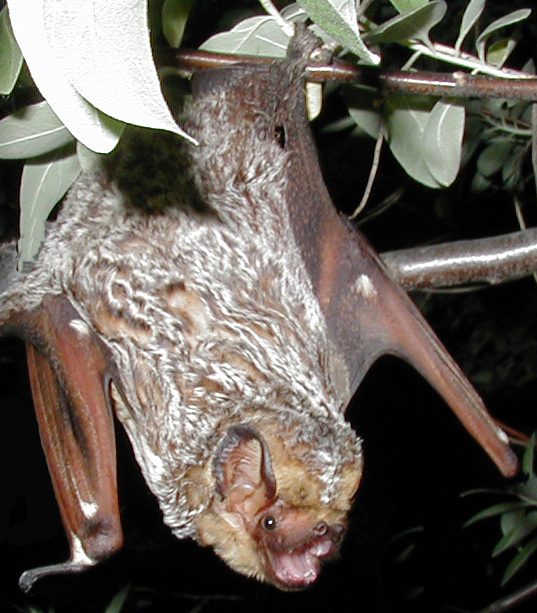
That matters in Louisville because the big brown bat is the species most often found in Colorado buildings, and the Colorado Bat Working Group describes summer groups in buildings as maternity colonies of females raising pups. Louisville's ponds, Coal Creek and open space produce the night-flying insects these bats eat, and houses a short flight away make convenient day roosts. CPW lists Boulder County among the counties where white-nose syndrome has been confirmed (Boulder, Douglas, El Paso, Grand, Jefferson, Larimer, Otero, Routt, Teller and Weld), which is one more reason to use live-release exclusion rather than anything that harms the colony.
Old Town, the Marshall Fire and how bats get in
Louis Nawatny filed the plat for Louisville on October 24, 1878, after coal was struck nearby the year before. The town's National Register nomination notes that almost all of old Louisville was built of wood: fewer than a dozen homes in the old town were brick or stone, because wood frames flexed better in a town that was being undermined by coal workings. Old wood-frame houses are where we most often find bats, at gaps along fascia boards, around chimneys, at loose siding and in open gable vents.
The other half of the story is new. The Marshall Fire of December 30, 2021 destroyed 550 homes in Louisville, according to Boulder County's assessment that January. As of December 1, 2025, the county reported building permits issued for 84% of the 1,109 homes destroyed across the fire area. New construction is tighter, but it is not bat-proof. Ridge-vent end caps, gaps where stone veneer meets siding, and unscreened gable or soffit vents are all openings we check on rebuilt homes.
Across the city, the Census Bureau estimates Louisville had 20,811 residents in 2024. Of its 8,497 housing units, the median was built in 1991; 20% predate 1980 and 18% went up in 2010 or later (ACS 2024 5-year). About 66% are single-family detached houses, 18% are in buildings with ten or more units, and 28% of homes are rented. A bat needs a gap only about the width of a thumb, and the Colorado Bat Working Group warns that sealing the main exit while bats are inside sends them looking for another way out, sometimes into the living space.
When bat exclusion can happen in Louisville
Colorado Parks and Wildlife asks property owners to avoid sealing bats out of buildings during pupping season, June through August. The Colorado Bat Working Group gives a slightly longer window (June to mid-August) and asks a simple question first: can the work wait until the maternity colony disperses in autumn? At the Boulder station, about seven miles west, the average November low is about 28°F, long after a maternity colony has broken up.
In Louisville, NOAA normals for the Boulder station put the average low at 50°F or warmer in Jun–Aug, the stretch when insects, and therefore bats, are most active. That lines up with the state window. We use those months for inspection and night exit counts. One-way doors go up after the pups can fly, and stay up for the 5–10 nights the Working Group recommends before the last gaps are sealed.
Louisville at a glance
- Housing units: 8,497 (median year built 1991)
- Built before 1980: 20%; built 2010 or later: 18%
- Single-family detached: 66%; buildings with 10+ units: 18%
- Renter-occupied homes: 28%
- Average January low: 22°F; average July high: 88°F
- Months with an average low of 50°F or warmer: Jun–Aug
Housing figures: U.S. Census Bureau, ACS 2024 5-year estimates (tables B25024, B25034, B25035, B25003) via Census Reporter. Climate: NOAA 1991–2020 normals, Boulder station.
Common questions
Who do I call about a bat in my Louisville home?
If anyone may have touched it, or it was in a room with someone asleep, call Boulder County Public Health at 303-441-1564 before releasing or disposing of the bat. For police and animal calls in Louisville, the non-emergency number is 303-441-4444. For wildlife questions, CPW is 303-291-7227.
Does Louisville animal control remove bats from attics?
No. Louisville Police Code Enforcement handles animal control, mainly domestic animals and nuisance complaints, and the city refers wildlife issues to dispatch, its Open Space rangers or CPW. A colony living in an attic or wall is private exclusion work.
How many rabid bats has Boulder County had?
Boulder County Public Health reports that seven bats tested positive for rabies in the county in 2025. In its 2026 weekly reports, every positive animal so far has been a bat. Most bats are not rabid, but a bat that is grounded, out in daylight or indoors should never be handled.
Did the Marshall Fire rebuilds make Louisville homes bat-proof?
Not automatically. New homes are tighter than 1880s miners' houses, but bats can still use ridge-vent end caps, unscreened gable or soffit vents and gaps where stone veneer meets siding. A bat needs a gap only about the width of a thumb.
When can bats be sealed out of a Louisville house?
Not during pupping season, June through August, per Colorado Parks and Wildlife. Once the young can fly, one-way devices go up and stay for 5 to 10 nights before the last gaps are sealed. Late summer and early fall are the usual window.
Nearby city guides
Sources
- Boulder County: Bat found in Boulder County tested positive for rabies (May 23, 2025; BCPH 303-441-1564)
- Boulder County Public Health: Animal-borne disease (vector control) weekly reporting
- City of Louisville: Louisville Police Department (Boulder Regional Communications Center; Code Enforcement 303-666-8634)
- Louisville Police Department Policy 806: Animal control (Code Enforcement primary responsibility, PDF)
- City of Louisville: Report a wildlife issue (dispatch 303-441-4444, Open Space rangers 303-335-4770)
- Colorado Parks and Wildlife: Contact us (regional and area offices)
- Adams & Bevan, University of Northern Colorado: Report for continued surveys for bats on Boulder County Open Space (2018, PDF)
- National Register of Historic Places: Louisville Multiple Resource Area nomination (History Colorado, PDF)
- Boulder County: Updated list of structures damaged and destroyed in the Marshall Fire (Jan. 6, 2022)
- Boulder County: Marshall Fire and wind event recovery (rebuilding progress as of Dec. 1, 2025)
- Colorado Parks and Wildlife: Living with Bats
- Colorado Bat Working Group (CNHP, CSU): excluding bats from buildings
- CDPHE: Colorado Rabies FAQ
- Colorado Parks and Wildlife: Protect your home from wildlife
- U.S. Census Bureau: City and town population estimates, Vintage 2024 (SUB-EST2024)
- Census Reporter: Louisville profile (ACS 2024 5-year)
- NOAA NCEI 1991–2020 monthly normals (Boulder)
Other Colorado cities we serve
We serve all of Colorado. Here are nearby service areas.
Other wildlife removal services we offer here
Louisville bat removal, done right.
Call for a phone consultation. Written warranty.