
How to Get Rid of Bats in Your Attic in Colorado, Humanely and Legally
Exclusion is the only humane, permanent, and legal way to remove a bat colony from a Colorado attic. Here is what the law requires and how the process actually works.
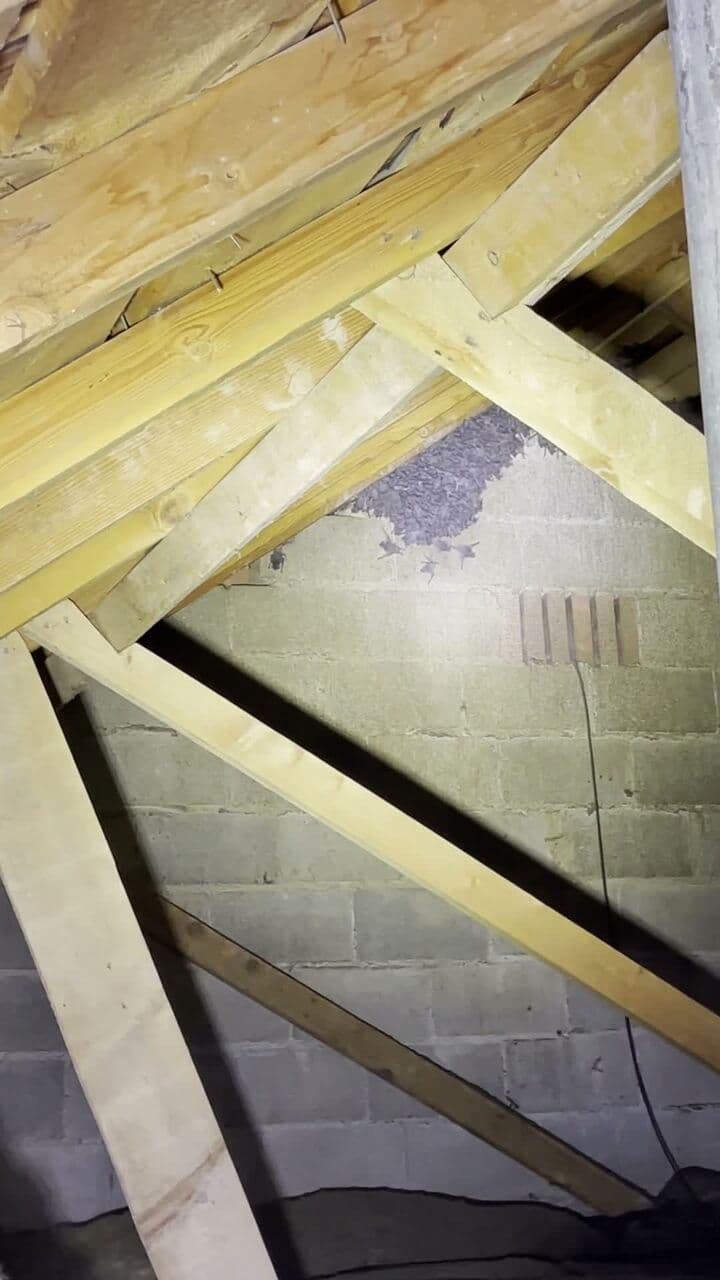
How do you get rid of bats in your attic?
You get bats out through exclusion, not traps or sprays. A trained technician installs one-way devices over the openings the colony uses to enter. The bats can leave to feed at night but cannot return. After three to seven days the attic is empty, every gap is sealed permanently, and the space is decontaminated. It is the only method that is humane, legal, and lasting in Colorado.
Exclusion works because it follows the colony's own exit behavior. Flying adults in a roost exit at dusk to hunt insects. Pups that cannot yet fly remain behind. A one-way tube or cone device lets them drop out normally but blocks the return flight. No poison is needed. No animal is sealed inside a wall. Within a week, the colony has relocated itself without any individual bat being harmed.
Is it legal to remove bats yourself in Colorado?
Killing bats in Colorado is illegal. All native bat species are protected under state nongame wildlife law, as Colorado Parks and Wildlife (CPW) explains on their bat guidance page. Even when a colony is genuinely disrupting your home, the answer is exclusion, not extermination.
There is also a timing consideration. Colorado Parks and Wildlife advises against bat exclusion from approximately June 1 through August 15, when females are raising pups that cannot yet fly. If the entry point is sealed while the colony is inside, the flightless young are trapped. They die in the attic, creating a far larger odor and health problem than the original colony caused. Licensed wildlife professionals time exclusion for the windows before and after this period, typically April through May and late August through October in the Front Range, in line with CPW guidance.
Townsend's big-eared bat carries an additional layer of protection. CPW lists it as a threatened species in Colorado, and it is highly sensitive to disturbance at roost sites. If a Townsend's colony is confirmed in your structure, handling involves more careful coordination. Most attic colonies are big brown bats, but identification matters before any work begins.
The bats most likely in a Colorado attic
The big brown bat (Eptesicus fuscus) accounts for the large majority of structure-roosting calls in Colorado. CPW describes it as more closely associated with human development than any other bat in North America. It roosts in attics, soffits, and wall voids, and unlike many bat species it can overwinter in a warm attic rather than migrating or seeking a cave. A Fort Collins study spanning 2001 to 2005 found that big brown bats actively select anthropogenic structures with warmer temperatures than nearby randomly sampled buildings, which explains why a sun-exposed south-facing attic is far more likely to attract a colony than a cooler north-facing one.
Two other species show up in Colorado attics with some regularity. The little brown myotis (Myotis lucifugus) forms large maternity colonies and is often found near water. Homes along the Big Thompson River corridor in Loveland, the Cache la Poudre drainage in Fort Collins, and irrigation-fed neighborhoods along the northern Front Range see more little brown bat activity. The hoary bat (Lasiurus cinereus) is a migratory species that passes through in spring and fall and occasionally ends up inside a structure during those transitions.
Boulder's mix of older brick and frame homes, many of them built in the early to mid-twentieth century with gaps that have never been properly sealed, creates ideal conditions for big brown bats and several myotis species. Townsend's big-eared bats inhabit nearby mine features and rock formations but rarely establish maternity colonies inside homes.
What the signs look like
The most reliable sign is the guano. Bat droppings accumulate directly below an active entry point and dry into a crumbly, slightly glittery powder. That texture is distinctive: mouse droppings are smooth and solid; bat guano breaks apart and turns dusty when touched. In Colorado's dry, high-altitude climate this desiccation happens faster than in wetter states, which increases the airborne dust risk when the deposit is disturbed.
Look also for dark, greasy staining around a gap in the roofline. Bats have oily fur, and repeated use of the same entry point leaves a faint brown smear on the wood or painted fascia. Other indicators include a faint ammonia smell coming from the attic, a soft chittering sound near dusk, and finding a single bat inside a bedroom or hallway. That last one is an important signal: bats do not wander inside by accident. They follow established flight paths to a roost. One bat in your living space can point to a colony roosting nearby, especially if you are also seeing guano, staining, odor, or dusk activity at a roofline gap.
Homes along the foothills corridor, from Highlands Ranch and Castle Rock north through Loveland to Fort Collins, are positioned near natural bat habitat. Bats that have historically used mine shafts and rocky outcroppings in the foothills increasingly move into warm attics as older mines are sealed, gated, or collapse. If your home backs up to a canyon or a hillside with visible mine workings, the pressure is higher than average.
Why repellents and sealing the hole backfire
No commercially available repellent reliably moves an established colony. Ultrasonic devices, mothballs, and strong-scented sprays have no demonstrated effect on bats that have committed to a roost. Bats in a maternity roost are highly motivated to stay near their young and will tolerate considerable irritation before relocating. A colony that chose a warm attic is unlikely to abandon it because of a plug-in device.
Sealing the entry hole yourself is the riskier mistake. If any bat is inside when you close the gap, it is trapped. During maternity season, dozens of flightless pups may be in the roost when the entry is blocked. A trapped colony that cannot escape will die inside the attic walls, producing an extended odor problem and a guano deposit that was already accumulating before the seal went in. That situation requires a more involved remediation than a standard exclusion would have. The correct sequence is always: wait for the full colony to exit, install one-way devices, monitor until the attic is empty, then seal permanently.
What the removal process looks like
A proper exclusion runs in four stages.
The first is an inspection of the roofline, attic, and any accessible wall voids. We identify the primary entry points the colony is using, note the secondary gaps that need sealing, and assess the guano accumulation. Bats can enter through very small gaps along the roofline, soffits, vents, and flashing, so this step is not a quick look; it is a methodical search of every potential opening in the building envelope.
Second, we install one-way exclusion devices over the active entries, and screen or seal the secondary gaps. The one-way devices stay in place while the colony works itself out over the next three to seven days. Every bat that exits cannot return, so the population inside drops each night.
Third, we monitor. This can mean a follow-up visit or a homeowner check at dusk to watch for any remaining flight activity at the entry points.
Fourth, we return to remove the exclusion devices and permanently seal every opening. If guano has built up over months or years, decontamination is scheduled as a separate service. Accumulated droppings in Colorado's dry climate carry an elevated dust risk and should be removed by someone with proper respiratory protection and disposal procedures.
The real risks: guano and rabies
Bat droppings can carry the spores of Histoplasma capsulatum, the fungus that causes histoplasmosis, a respiratory illness. The CDC recommends that large accumulations of bat guano be cleaned by professionals equipped for hazardous-material removal. In Colorado, the low humidity accelerates drying, which means guano turns to airborne dust more quickly than it would in a humid climate. Never sweep or vacuum a dry attic deposit without a properly rated respirator. Even disturbing the pile while pulling down old insulation can release enough spores to cause illness.
The second risk is rabies. The CDC notes that bats account for roughly 70 percent of human rabies deaths in the United States. The actual percentage of bats that carry the virus is small, but bat bites are often too fine to feel, especially on a sleeping person, which makes exposure harder to detect than a bite from a larger animal. Colorado Department of Public Health guidelines recommend that anyone who may have been in direct contact with a bat, including waking up in a room where a bat was found, consult with their local health department about rabies exposure evaluation before the animal is released. If you capture a bat indoors, keep it for testing if possible.
A long-running colony also causes straightforward structural damage: urine soaks into insulation and wood framing, guano can corrode metal fasteners, and stained ceilings become a disclosure and repair problem. The sooner a colony is addressed, the less cleanup the situation requires.
When to call, and the timing that matters in Colorado
Call as soon as you suspect a colony is present. A small roost of a dozen bats can grow significantly within a few seasons as pups mature and return to the same site. Waiting until the colony is large means more entry points, more guano, and a bigger job.
The best windows for exclusion on the Front Range are spring and fall. Spring work, typically April through late May, targets the period before females arrive to give birth. Fall work, running from late August through October, waits until the pups are flying independently, so the whole colony can exit freely before any gap is sealed. Both windows avoid the June 1 to August 15 maternity restriction outlined by Colorado Parks and Wildlife.
If you are seeing bats inside the living space now, that is an immediate situation regardless of season. A single bat in a bedroom may constitute a rabies exposure event. Do not wait for the right exclusion window to call. Handle the immediate safety question first, then schedule the structural exclusion for the appropriate season.
Frequently asked questions
How long does bat removal take in Colorado?
Most jobs run one to two weeks from start to finish. Once one-way exclusion devices go in, the colony clears itself in three to seven days because every bat leaves each night to hunt. We then return to remove the devices, seal every entry point permanently, and schedule guano cleanup if needed.
Can I have bats excluded in the summer?
Not with full exclusion during maternity season. Colorado Parks and Wildlife advises against exclusion from approximately June 1 through August 15 because flightless pups are in the roost. Sealing the entry during that window would trap the young inside. A bat that has entered your living space can still be handled as an immediate safety situation regardless of season.
How much does bat removal cost in Colorado?
Cost depends on colony size, the number of entry points, and whether guano cleanup is needed. We provide a written estimate after a free inspection. See our bat removal page for a full breakdown of what affects the price.
Will bats come back after exclusion?
Not when the work is done correctly. Once every bat has exited and every gap is sealed with the right materials, the entry points are permanently closed. Our exclusion work is backed by a written warranty. If a bat re-enters through an area we sealed, we return at no additional charge.
Related reading
Wildlife in your home? Contact us today.
Call for a phone consultation.