
Pigeons Under Your Solar Panels: A Colorado Homeowner's Guide to Fixing It for Good
Pigeon nesting does not stop when summer ends. A Colorado State University fact sheet puts rock pigeon reproduction at its peak in spring and fall, so a new nest under your solar array this autumn is right on schedule. Sorting it out means dealing with the birds, the wiring, and the roof in the right order.
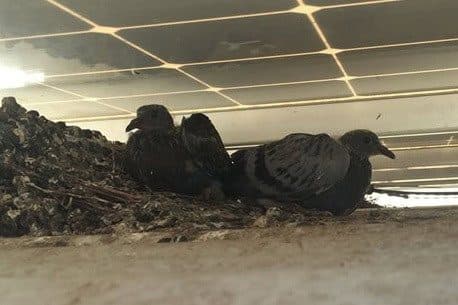
Fall is pigeon nesting season too
A lot of homeowners assume bird problems are a spring thing. With pigeons, that assumption does not hold. The Colorado State University pigeon fact sheet says breeding may occur in all seasons, with peak reproduction in spring and fall. The shaded, sheltered gap under a rooftop solar array is about as good as a nest site gets for them: a flat surface, shelter from rain, snow, and sun, and cover from predators.
Other gaps along the same array offer the same shelter. By the time droppings are streaking the gutters, assume there may be more than one nest up there and check the whole perimeter.
Confirm what is under the array
Before anyone climbs a ladder, gather what you can from the ground. Ten minutes with binoculars around dusk will usually show you where the birds are going in.
Signs that birds are nesting under the panels:
- Birds flying directly into the gap between the panel edge and the roof, then disappearing
- Cooing or scratching from the roof near the array, especially early and late in the day
- Droppings building up on the roof below the panel edge, in the gutters, or on the patio underneath
- Twigs, feathers, and debris poking out from the panel perimeter
- Wires hanging loose or pulled up between modules
That last one matters most. The U.S. Department of Energy's guide for solar system owners tells inspectors to look for piles of sticks, leaves, feathers, and other dry debris, and notes that an animal will usually leave signs around the perimeter even when the nest itself sits in the center of the array. The same guide flags wires pulled up between modules as a warning sign.
Take photos from the ground and note which sections of the array show activity. Those photos help your solar provider, and they give you a before record to compare against once the work is done.
Pigeon or mourning dove? The answer changes the rules
Rock pigeons and mourning doves can look alike from the ground, and CSU notes they are sometimes confused. Pigeons are larger and plumper, usually bluish gray with two dark bars across the wing. Mourning doves are slimmer, tan to buff, with black spots on the wings and white-tipped tail feathers.
People brought the rock pigeon to this continent, and for that reason the U.S. Fish and Wildlife Service gives it no protection under the migratory bird law. State rules line up with that. Under Colorado Parks and Wildlife rules, common pigeons damaging private property can be taken by the owner, or by someone working for them, with no permit required.
Mourning doves are native, and the federal regulations at 50 CFR 10.13 name them among the birds the treaty protects. Federal policy treats a protected bird's nest with viable eggs or nestlings as off limits without authorization. If doves or other native birds are nesting under your panels alongside pigeons, the timing of the cleanout has to respect that.
What is at stake under the panels
Droppings are the visible problem. The wiring is the more serious one. The Department of Energy guide describes birds, squirrels, and other small animals building nests under or behind arrays because the spot is shielded from weather and predators. Wires in those nesting areas are often chewed. Once the insulation is compromised, copper strands can be exposed, which the guide says can lead to shock hazards and electrical faults. The guide names squirrels as array nesters too, and our post on squirrels in Colorado attics covers what their chewing does to wiring.
The same document goes further in its corrective action section. It says damaged wires and dry nest material have the potential to start a fire, and that nests should be removed from the array. It also points out that wires pulled up onto the surface of the array degrade faster because they are now exposed to sun, wind, and snow.
Then there is the mess itself. Accumulated droppings stain the roof and panel frames, wash into gutters, and create a cleanup job nobody wants to do by hand. The CDC advises that large amounts of bird droppings be cleaned up by professionals.
Talk to your solar provider before anything is attached
This step is easy to skip, and it saves headaches later. Before any guard goes on, call the company that installed or services your system and ask a few plain questions:
- Do you have requirements for how guards or mesh attach to the panels or racking?
- Are there parts of the array or wiring you want to inspect yourselves once the nests are out?
- Do you need to be notified before, or after, work is done around the modules?
If the system is leased or owned by a third party, they may have their own process too. Getting those answers first keeps the wildlife work and the solar work from undoing each other. If wiring damage turns up during cleanout, that repair belongs to a qualified solar or electrical technician. The DOE guide is blunt that a storm-damaged system should be considered unsafe until a qualified electrician or technician makes it safe, and chewed wiring deserves the same caution.
A full-perimeter fix, not a patch
A partial job is the easiest way to get the problem back. Guard three sides of an array and the birds walk in through the fourth. Guard one section and they move to the next. The fix has to follow the whole perimeter of every array on the roof.
A complete job usually goes in this order:
- Confirm species and nest status. Pigeon nests can be cleared at any time of year under the CPW rule for property damage. Protected birds, if present, set the timing for their nests.
- Remove nests, debris, and droppings from under and around the panels, with care around wiring.
- Clean and sanitize the affected roof surface and panel frames.
- Fit guards to the panel configuration. The DOE guide describes wire-based critter guards and netting installed around flush-mounted arrays to keep animals from nesting underneath, and notes that metal wire guards hold up in severe weather.
- Address perching on the top edge or nearby ledges if birds are loafing there. The DOE guide lists bird spikes for that purpose. CSU lists exclusion among its pigeon techniques and says noise makers and predator models often fail to provide long-term control.
Colorado Wildlife Specialists treats solar panel pigeon removal as a specialty. We remove droppings, nesting, and debris, then install custom critter guards fitted to your panel layout, and our critter guard installations for solar panels carry a lifetime warranty, as described on our pigeon control page.
After the guards go on
Ask for a handoff when the job is done, including before and after photos of each array edge so you have a record of what was done and where. Then keep an eye on a few things over the next season:
- Birds landing on the ridge or panel tops and lingering
- New droppings appearing below one particular section
- Any spot where a guard has shifted after heavy snow or wind
- Service visits from your solar company that require removing a panel, since guards need to go back on correctly afterward
Pigeons are persistent. Once there is no gap left to get into, though, the array stops being a nest site. If you are watching birds dive under your panels this fall, set up an inspection and we will map the activity, clear it out, and close it up.
Frequently asked questions
Are pigeons protected in Colorado?
No. Rock pigeons were brought to North America by people, so federal wildlife officials do not treat them as protected migratory birds. Under Colorado Parks and Wildlife rules, pigeons damaging private property can be taken by the owner or someone working for them without a permit. Mourning doves are a different matter. They look similar at a glance and are on the federal protected list, so confirm which bird is under the array before any nest comes out.
Will a plastic owl keep pigeons off my solar panels?
Not for long. Colorado State University's pigeon fact sheet says noise-making devices and predator models vary in effectiveness and often fail to provide long-term control. Physically closing the gap under the panels is what keeps them out.
Can a pigeon nest under solar panels damage the system?
It can. The U.S. Department of Energy's guide for solar owners says animals nesting under arrays often chew wires, which can expose copper strands and possibly lead to shock hazards and electrical faults, and that damaged wires combined with dry nest material have the potential to start a fire. The guide lists nest removal as a corrective action.
Should I clean out the nests myself?
We would not recommend it. The job means working on a roof around energized equipment, which the Department of Energy's guide lists alongside fall hazards and contact with disease-carrying animals as safety concerns. The CDC also advises that large amounts of bird droppings be cleaned up by professionals.
Related reading
Pigeons nesting under your panels?
We clear the nests and droppings, then fit critter guards to your panel layout.