
Bat Removal Durango, CO
Durango has changed how it handles animal calls. Since January 1, 2026, animal control inside city limits has been run by the Durango Police Department, not the La Plata County Humane Society, and public health has been a county department since 2024. Here is who to call about a bat in Durango, what local rabies cases show, and why the window for sealing a roost is shorter here than on the Front Range.
Who to call about a bat in Durango
For more than 20 years the La Plata County Humane Society provided animal protection officers to the City of Durango under contract. The city announced in October 2025 that it would take the work in-house, and did so on January 1, 2026. Animal control is now handled by rangers working under the Durango Police Department, who respond to stray, dangerous, neglected and nuisance animals and coordinate rabies quarantines. The department reached full staffing, with two animal control rangers, in May 2026. The Humane Society still runs the shelter.
- Emergencies: 911.
- Animal calls inside Durango city limits: Durango Emergency Communications Center, the 24-hour non-emergency line, 970-385-2900. Durango Police Department's main line is 970-375-4700.
- Outside city limits: La Plata County Animal Protection, also reached through Central Dispatch at 970-385-2900.
- Possible exposure or bat testing: La Plata County Public Health Department, 970-247-5702, and your own medical provider.
- Wildlife questions: Colorado Parks and Wildlife's Durango office, 970-247-0855.
San Juan Basin Public Health, the district agency many residents still remember, was dissolved at the end of 2023. La Plata County took over its programs on January 1, 2024, and the number, 970-247-5702, stayed the same.
What La Plata County Public Health asks you to do
The county's communicable disease team says a bat should never be in your home and that bat bites are small and hard to notice, especially on children and pets. If you find a bat inside or have had contact with one, it should be tested. The county's capture steps: put on leather work gloves, place a plastic container or box over the bat, slide a piece of cardboard with holes punched in it underneath, tape it shut, and put it in the refrigerator, which makes the bat inactive. Then call public health to arrange delivery to its team or a partner veterinarian. The bat is sent to the state lab. A negative test means no rabies shots are recommended; a positive one means a post-exposure series is. A bat found on the ground should be left alone and reported. Our guide to finding a bat in your house covers the rest.
Rabid bats in La Plata County
Rabies turns up in local bats every few years. In June 2022 a bat found inside a home in the Bayfield area tested positive, and the people and pets in the home received treatment. In August 2022 a second bat, found northeast of Durango, tested positive after a person had contact with it. In June 2023 a bat found in a Durango-area home tested positive; no one had touched it, but the vaccinated pets that were exposed got booster shots. In March 2025 the Humane Society described that June 2023 bat as the most recent known rabies case in the county. Most bats are not rabid, but the cases show why an indoor bat is worth testing rather than releasing.
A railroad town on the Animas
The Denver & Rio Grande Railway laid out Durango along the Animas River in September 1880 to serve the San Juan mining district, just south of the older Animas City, which the new town eventually annexed. It became the La Plata County seat, sits at about 6,512 feet, and is home to Fort Lewis College. The Census Bureau's Vintage 2024 estimate puts Durango at 19,811 residents.
Of Durango's 9,634 housing units, 42% were built before 1980 and 19% in 2010 or later; the median home was built in 1989. Only 48% are single-family detached houses, 19% are in buildings with 10 or more units, and 47% of homes are rented (ACS 2024 5-year), a high share for a city its size, partly reflecting the student population at Fort Lewis College. Brick and frame buildings downtown and in the older neighborhoods have gaps at cornices, chimney flashing and attic vents. Newer homes in the hills around town have them where a garage roof meets a wall and at soffit returns. A gap about the width of a thumb is enough. In a rental, exterior sealing is the owner's job, so tell the landlord or manager early.
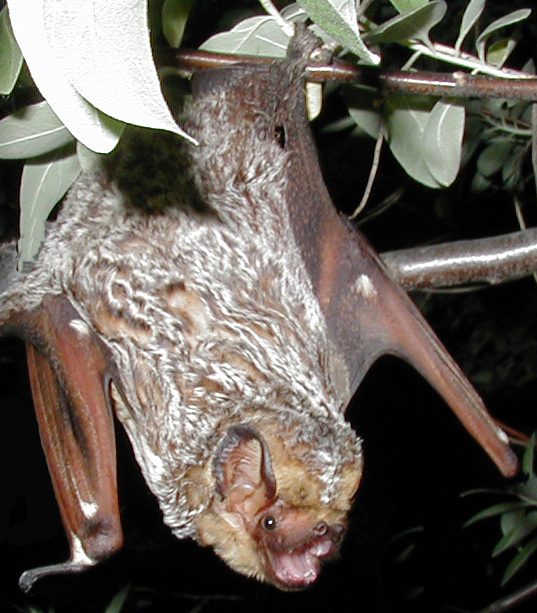
The Animas River corridor and the forested slopes around town supply the night-flying insects bats eat. The big brown bat is the species found most often in Colorado buildings, and the Colorado Bat Working Group describes summer colonies in buildings as maternity groups of females raising pups. Blocking their exit while they are inside can push them toward the living space, which is why we use one-way devices instead of simply plugging holes.
When bat exclusion can happen in Durango
Colorado Parks and Wildlife asks property owners to avoid sealing bats out of buildings during pupping season, June through August. The Colorado Bat Working Group gives a slightly longer window (June to mid-August) and asks a simple question first: can the work wait until the maternity colony disperses in autumn? Durango has less room for error than lower towns. The Durango station averages a September low near 44°F and an October low near 33°F, so once pups are flying in late summer, the exclusion and final sealing should be done promptly.
In Durango, NOAA normals for the Durango station put the average low at 50°F or warmer in Jul–Aug, the stretch when insects, and therefore bats, are most active. That lines up with the state window. We use those months for inspection and night exit counts. One-way doors go up after the pups can fly, and stay up for the 5–10 nights the Working Group recommends before the last gaps are sealed.
Durango at a glance
- Housing units: 9,634 (median year built 1989)
- Built before 1980: 42%; built 2010 or later: 19%
- Single-family detached: 48%; buildings with 10+ units: 19%
- Renter-occupied homes: 47%
- Average January low: 13°F; average July high: 85°F
- Months with an average low of 50°F or warmer: Jul–Aug
Housing figures: U.S. Census Bureau, ACS 2024 5-year estimates (tables B25024, B25034, B25035, B25003) via Census Reporter. Climate: NOAA 1991–2020 normals, Durango station.
Common questions
Who do I call about a bat in my Durango home?
Inside city limits, call the Durango Emergency Communications Center non-emergency line, 970-385-2900; since January 2026 animal calls go to Durango Police Department animal control rangers. If anyone may have touched the bat or slept in the room with it, also call La Plata County Public Health at 970-247-5702 and your doctor.
Does the La Plata County Humane Society still handle animal control in Durango?
Not inside the city. The Humane Society provided animal protection to Durango for more than 20 years, but the city took over enforcement on January 1, 2026. The Humane Society still runs the shelter. Outside city limits, La Plata County Animal Protection is reached through Central Dispatch at 970-385-2900.
What happened to San Juan Basin Public Health?
It was dissolved, and La Plata County took over its programs on January 1, 2024. The La Plata County Public Health Department kept the same number, 970-247-5702, and handles bat testing and rabies exposure questions.
Have rabid bats been found around Durango?
Yes. Bats tested positive in the Bayfield area in June 2022, northeast of Durango in August 2022, and in a Durango-area home in June 2023. In March 2025 the Humane Society called the 2023 bat the most recent known rabies case in the county.
When can bats be sealed out of a Durango home?
Not during pupping season, June through August, per Colorado Parks and Wildlife. After the young can fly, one-way devices stay up for 5 to 10 nights before the final gaps are sealed. Durango cools fast in fall, so late August and September is the usual window.
Nearby city guides
Sources
- Durango Herald: Understanding animal protection as city of Durango takes the lead (La Plata County Humane Society, Oct. 21, 2025)
- Durango Herald: Durango police animal control fully staffed for first time since taking over services in 2026 (May 15, 2026)
- City of Durango: Police Department contact (970-375-4700; non-emergency dispatch 970-385-2900)
- City of Durango: 911 Communications, Durango Emergency Communications Center (non-emergency 970-385-2900)
- La Plata County Humane Society: Contact Animal Protection (Central Dispatch 970-385-2900)
- La Plata County Public Health Department: Board of Health (took over from San Juan Basin Public Health Jan. 1, 2024; 970-247-5702)
- Durango Herald: Of mice and bats, how to avoid hantavirus and rabies this spring (La Plata County Public Health, Mar. 16, 2025)
- Durango Herald: Rabies, what La Plata County residents need to know (La Plata County Humane Society, Mar. 12, 2025)
- Southern Ute Drum: Bat found in La Plata County home tests positive for rabies (Bayfield area, June 30, 2022)
- Southern Ute Drum: Second bat tests positive for rabies in La Plata County (Aug. 11, 2022)
- Southern Ute Drum: Bat found in La Plata County home tests positive for rabies (Durango area, June 15, 2023)
- City of Durango: Living with Wildlife (CPW Durango office 970-247-0855)
- Colorado Parks and Wildlife: Contact us (regional and area offices)
- City of Durango: History (formed by the Denver & Rio Grande in September 1880)
- SAH Archipedia: Durango (county seat, 1880, 6,512 feet; Animas City annexed)
- U.S. Census Bureau: City and town population estimates, Vintage 2024 (SUB-EST2024)
- Colorado Parks and Wildlife: Living with Bats
- Colorado Bat Working Group (CNHP, CSU): excluding bats from buildings
- CDPHE: Colorado Rabies FAQ
- Colorado Parks and Wildlife: Protect your home from wildlife
- Census Reporter: Durango profile (ACS 2024 5-year)
- NOAA NCEI 1991–2020 monthly normals (Durango)
Other Colorado cities we serve
We serve all of Colorado. Here are nearby service areas.
Other wildlife removal services we offer here
Durango bat removal, done right.
Call for a phone consultation. Written warranty.