
Bat Removal Frederick, CO
Frederick has added hundreds of homes a year for two decades, and almost every house in town is a detached single-family home. Bats do not care how new a house is. They need a gap, a warm attic or wall, and insects nearby, and Frederick has all three. Here is how the town divides up bat calls, when Weld County public health gets involved, and how a colony is moved out without trapping pups inside.
How Frederick handles bat calls
Frederick does not run a full animal control unit. The police department's Community Service Unit does code enforcement and limited animal control, and the town says that work is focused mainly on dogs. Its wildlife page groups bats with raccoons, skunks and coyotes as protected species under state wildlife jurisdiction and sends questions about them to Colorado Parks and Wildlife. There is one exception worth knowing: the town asks residents to call the Community Service Unit when an animal seems sick or is acting abnormally, and its example is a bat that is very active in daylight. The unit may then contact CPW, which reports such animals to the state health department.
- Emergencies: 911.
- A bat flying around in daylight, or one that is grounded and acting sick: Frederick non-emergency dispatch, 720-652-4222, for the Community Service Unit.
- Anyone may have touched the bat, or it was found where someone was sleeping or a child or pet was alone: Weld County Department of Public Health and Environment (WCDPHE), 970-400-2290. Weld County's regional dispatch center, 970-350-9600, also connects callers with local animal control.
- General bat and wildlife questions: CPW customer service, 303-297-1192, the number the town lists.
None of those agencies removes a colony from an attic or wall. That is private exclusion work.
What to do with a bat inside
Weld County's rule of thumb is simple: if there was any chance of contact, keep the bat. Close it into one room, put on leather gloves if it is safe to do so, and trap it in a coffee can or similar container with a tight lid, poking small air holes if it is alive. Call WCDPHE before throwing anything away, so the bat can be tested. If you are sure no person or pet touched it, open a window and let it out. Our guide to finding a bat in your house covers both situations step by step.
Rabies numbers for Weld County and Colorado
Bats are the animal most often found rabid in Colorado. The Colorado Department of Public Health and Environment counted 58 rabid animals statewide in 2024, and 56 of them were bats. Weld County's own table shows 6 rabid bats in 2024 and 5 in 2025, with skunks the only other species on the 2025 list. Those figures come only from animals that were submitted for testing, which usually happens because someone had contact. Most bats are not rabid, but rabies cannot be ruled out by looking at the animal, which is why testing matters after a bedroom or nursery encounter.
Frederick's houses, and where bats get in
The town was incorporated in 1907 by three young women who named it for their father, landowner Frederick A. Clark, and it grew up around coal mines worked largely by Italian immigrants. The mines are long gone. The Census Bureau's Vintage 2024 estimate is 17,937 residents, up from 14,527 at the 2020 base, and the town says it builds more new homes each year than Longmont, Firestone and Dacono combined.
The housing numbers reflect that. Of Frederick's 5,930 housing units, the median was built in 2008; 43% went up in 2010 or later and only 5% before 1980. About 95% are single-family detached houses and just 5% of homes are rented (ACS 2024 5-year). So in Frederick the person dealing with bats is almost always the owner. On houses this new, the openings are usually not rot or failed wood. They are:
- the seam where a lower roof, such as a garage or porch, dies into a second-story wall, often covered only by a short piece of flashing;
- the open ends of ridge vents and the gap between the ridge cap and the last shingle;
- the joint where stone or brick veneer meets siding, a common accent on newer Front Range houses;
- gable and soffit vents whose screens were never fastened, or have pulled away;
- gaps around the utility and dryer penetrations high on a wall.
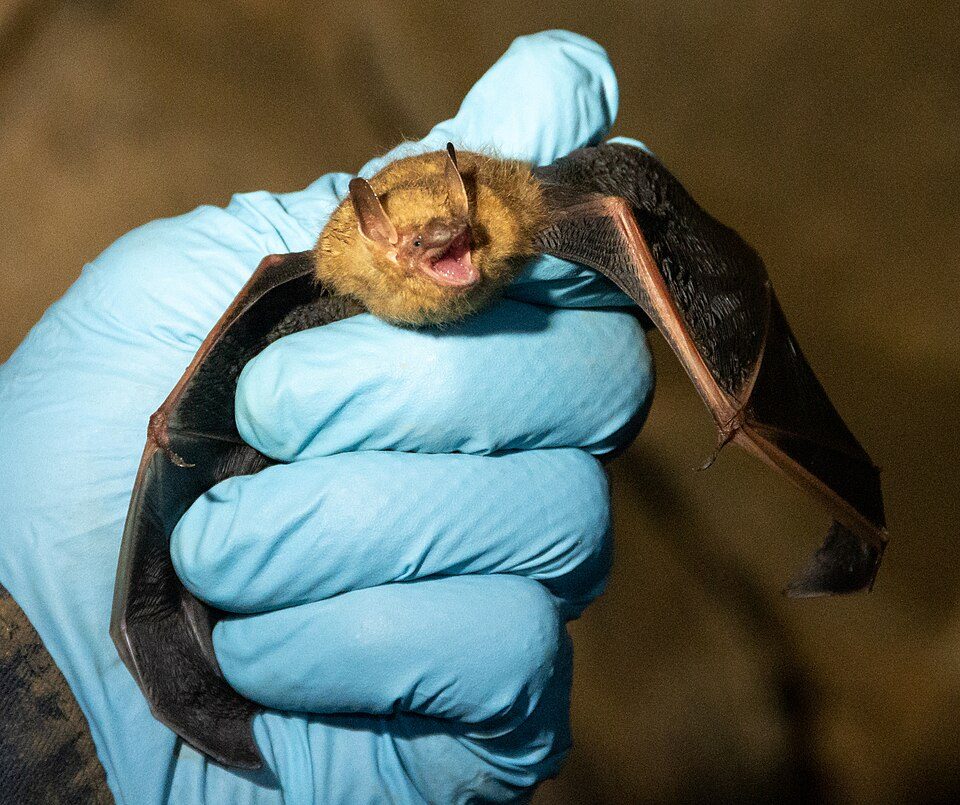
A big brown bat, the species CPW and the Colorado Bat Working Group find most often in buildings, can use a gap about the width of a thumb. Frederick's lakes and wetlands, including Milavec Lake at the Frederick Recreation Area and Bulrush Wetland Park, and the open land between subdivisions produce the night-flying insects bats feed on.
Builders, warranties and HOAs
If your house is still under a builder's warranty, photograph the entry points and droppings before any work is done and ask the builder whether an unsealed vent or flashing gap is covered. Many Frederick neighborhoods have HOAs. Exclusion devices are temporary, and the permanent seal uses sealant, flashing and screen colored to match the existing trim, which usually raises no covenant issues.
When bat exclusion can happen in Frederick
Colorado Parks and Wildlife asks property owners to avoid sealing bats out of buildings during pupping season, June through August. The Colorado Bat Working Group gives a slightly longer window (June to mid-August) and asks a simple question first: can the work wait until the maternity colony disperses in autumn? Frederick has no NOAA normals station of its own; the Longmont 2 ESE station, about 7 miles northwest, averages a September low near 46°F and an October low near 33°F, so late August through September is the practical window after pups can fly.
In Frederick, NOAA normals for the Longmont 2 Ese station put the average low at 50°F or warmer in Jun–Aug, the stretch when insects, and therefore bats, are most active. That lines up with the state window. We use those months for inspection and night exit counts. One-way doors go up after the pups can fly, and stay up for the 5–10 nights the Working Group recommends before the last gaps are sealed.
Frederick at a glance
- Housing units: 5,930 (median year built 2008)
- Built before 1980: 5%; built 2010 or later: 43%
- Single-family detached: 95%; buildings with 10+ units: 1%
- Renter-occupied homes: 5%
- Average January low: 14°F; average July high: 91°F
- Months with an average low of 50°F or warmer: Jun–Aug
Housing figures: U.S. Census Bureau, ACS 2024 5-year estimates (tables B25024, B25034, B25035, B25003) via Census Reporter. Climate: NOAA 1991–2020 normals, Longmont 2 Ese station.
Common questions
Does Frederick animal control remove bats?
No. The Frederick Police Community Service Unit does limited animal control focused on dogs, and the town refers bats and other wildlife to Colorado Parks and Wildlife at 303-297-1192. Removing a colony from a house is private work.
I saw a bat flying around my Frederick yard in the middle of the day. Who do I call?
The town asks residents to report wild animals that seem sick or are acting abnormally, and gives a bat active in daylight as its example. Call non-emergency dispatch at 720-652-4222 for the Community Service Unit, and keep people and pets away from it.
Should I let a bat go if I find it in my house?
Only if you are certain no one touched it and it was not in a room where someone was sleeping or a child or pet was alone. Otherwise, contain it in a lidded container and call Weld County public health at 970-400-2290 so it can be tested.
How common is rabies in Colorado bats?
Bats are the main source. CDPHE counted 58 rabid animals in Colorado in 2024, 56 of them bats, and Weld County recorded 6 rabid bats in 2024 and 5 in 2025. Those counts come from tested bats, most of which were tested after contact.
When can bats be sealed out of a Frederick house?
Not during pupping season, June through August, per Colorado Parks and Wildlife. After the young can fly, one-way devices stay in place for 5 to 10 nights before the final openings are sealed. Late August and September is the usual window.
Nearby city guides
Sources
- Town of Frederick: Reporting wildlife issues (bats under CPW, 303-297-1192; Community Services Unit for sick or abnormally active animals)
- Town of Frederick: Code enforcement FAQs (Community Service Unit limited animal control, primarily dogs; non-emergency dispatch 720-652-4222)
- Town of Frederick: Our history, our future (incorporated 1907; coal miners; Milavec Lake; hundreds of new homes a year)
- Weld County Department of Public Health and Environment: Rabies (bat exposure guidance; historical rabies cases by year)
- KRDO: Bat in Weld County tests positive for rabies, marking first case in Colorado this year (May 8, 2025; CDPHE: 58 rabid animals statewide in 2024, 56 of them bats)
- CDPHE: Historical rabies data (rabid animals by county and species)
- Colorado Parks and Wildlife: Contact us (regional and area offices)
- U.S. Census Bureau: City and town population estimates, Vintage 2024 (SUB-EST2024)
- Colorado Parks and Wildlife: Living with Bats
- Colorado Bat Working Group (CNHP, CSU): excluding bats from buildings
- CDPHE: Colorado Rabies FAQ
- Colorado Parks and Wildlife: Protect your home from wildlife
- Census Reporter: Frederick profile (ACS 2024 5-year)
- NOAA NCEI 1991–2020 monthly normals (Longmont 2 Ese)
Other Colorado cities we serve
We serve all of Colorado. Here are nearby service areas.
Other wildlife removal services we offer here
Frederick bat removal, done right.
Call for a phone consultation. Written warranty.