
Bat Removal Evergreen, CO
Evergreen sits in the foothills west of Denver, around a lake that local naturalists count among the best bat-watching spots in the area. Most of those bats feed over the water and never come near a house. The ones that move into attics, log walls and chimneys are a different story. Here is who handles bats in Evergreen, what Jefferson County's rabies records show, and when a roost can be closed.
Evergreen is county territory
Evergreen is not a city. It is an unincorporated community and census-designated place governed by Jefferson County, in the Front Range foothills about 19 miles west of Denver. The area was first settled in 1859, took its name from the evergreen trees around it, and got a post office in 1876. The CDP covers about 7,427 acres, including Evergreen Lake, and had 9,307 residents in 2020. Many Evergreen mailing addresses fall outside the CDP line, but the agencies below serve those homes too as long as they are in unincorporated Jefferson County.
Evergreen's housing is mostly older single-family homes. Of its 3,893 housing units, the median was built in 1976, 61% predate 1980 and only 5% went up in 2010 or later. 87% are single-family detached houses and 11% are rented (ACS 2024 5-year). Older mountain homes commonly have wood or log exteriors, decks, chimneys and decades of add-ons, which give bats more places to get in.
Who to call about a bat in Evergreen
- Emergencies: 911.
- A bat in the house, or a bat that touched a person or pet: Jefferson County Animal Control, part of the Sheriff's Office, 303-271-5070 during business hours and 303-980-7300 after hours. It serves unincorporated Jefferson County, including Evergreen, and lists rabies exposure among the wildlife concerns it handles.
- Health questions and exposure assessment: Jefferson County Public Health, 303-232-6301.
- Wildlife questions: Colorado Parks and Wildlife, Denver office, 303-291-7227. CPW also asks people to report active or dead bats seen between December and June to its white-nose line, 303-291-7771.
Jefferson County Public Health's advice for waking up to a bat in the room is simple: don't touch it, close it in the room if that's safe, call animal control and don't release it until animal control has decided whether it should be tested. A bat that has been tested negative usually means no rabies shots. No county office removes a colony from a house. That is the owner's job, or the landlord's if you rent.
Rabid bats around Evergreen
CDPHE's county tables listed 8 rabid bats in Jefferson County in each of 2017, 2018 and 2019, alongside 20, 18 and 9 rabid skunks. Two Evergreen reports stand out. In July 2018, Jefferson County Public Health reported that a bat found near Alderfer/Three Sisters Park in Evergreen had tested positive for rabies. In June 2026, an injured bat was reported near the Evergreen Lake Trailhead, but animal control officers could not find it when they arrived. Because it couldn't be tested, the county asked anyone who might have touched it to contact a health-care provider or JCPH for a risk assessment. Statewide, UCHealth reported 31 rabid bats among 43 rabid animals by late August 2026.
The Evergreen Lake case shows why a bat should be contained, not chased off: once it's gone, testing is impossible and doctors may recommend shots to be safe. Our guide to finding a bat in your house walks through how to cover one safely.
The bats of Evergreen Lake and Bear Creek
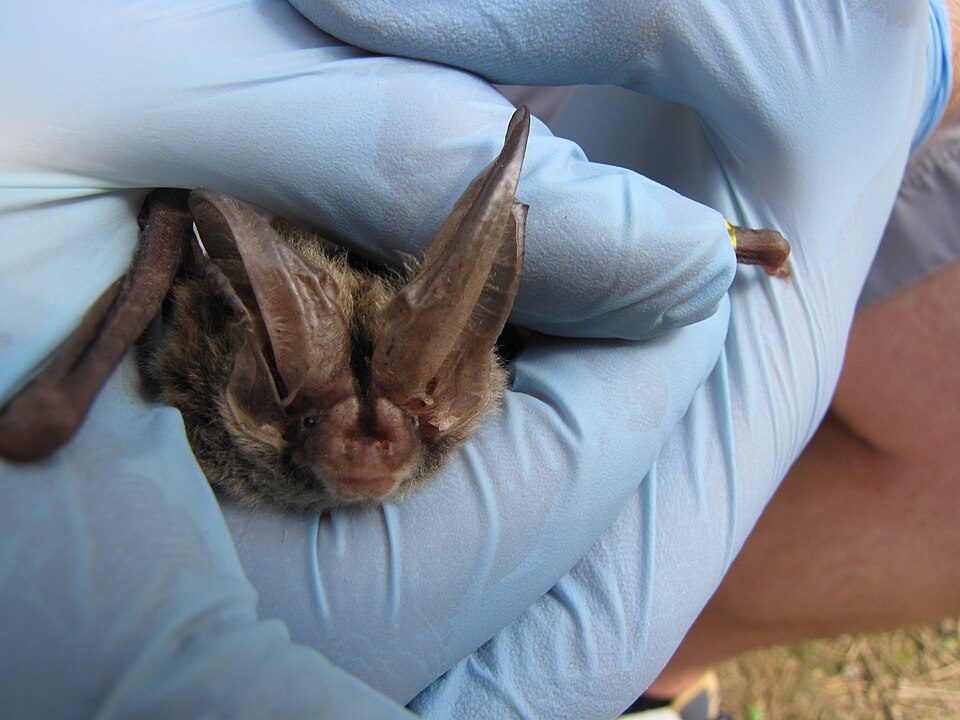
Evergreen Audubon's local bat expert lists nine species that can be seen in the Bear Creek watershed. The little brown myotis is the most common bat over Evergreen Lake, the big brown bat is the most common bat in Colorado, and the silver-haired bat is the most common in the surrounding forest. Hoary bats, western long-eared, long-legged, small-footed and fringed myotis and Townsend's big-eared bats round out the list. On an Evergreen Audubon bat walk in September 2023, an acoustic detector picked up eight species at the lake in about an hour, including Mexican free-tailed bats, which had only recently been recorded in Evergreen.
Most of those species roost in trees, rock crevices or old mines. The species most likely to move into buildings are big brown bats and little brown myotis, which use attics, wall voids and the space behind siding and chimneys. Both are on Colorado Parks and Wildlife's list of species affected by white-nose syndrome, and Jefferson County is among the counties with confirmed cases (Boulder, Douglas, El Paso, Grand, Jefferson, Larimer, Otero, Routt, Teller and Weld). We use only one-way devices that let bats leave on their own, and we decontaminate gear between jobs.
Where bats get into Evergreen homes
- gaps where log ends, chinking or cedar siding have shrunk away from trim and window frames;
- loose flashing and mortar around stone chimneys, and uncapped chimney flues;
- the joint where a deck ledger, addition or garage roof meets the original house;
- gable vents, soffit vents and ridge vent ends with torn screen;
- gaps at fascia and soffit corners, especially on steep roofs where snow and ice have pried trim loose.
The Colorado Bat Working Group's rule of thumb is that a gap about the width of a thumb is enough for a big brown bat, so sealing has to cover every opening, not just the one where bats were seen.
A short, cool bat season
Evergreen has its own NOAA weather station, about 1 mile from the CDP's center. Its 1991–2020 normals put the July high near 81°F and the January low near 12°F. Average lows never reach 50°F in any month, and they fall to about 40°F in September and 29°F in October. Bats here have a shorter, cooler season than on the plains, so the window between pups flying and bats leaving for winter is tight.
When bat exclusion can happen in Evergreen
Colorado Parks and Wildlife asks property owners to avoid sealing bats out of buildings during pupping season, June through August. The Colorado Bat Working Group gives a slightly longer window (June to mid-August) and asks a simple question first: can the work wait until the maternity colony disperses in autumn?
In Evergreen we plan one-way devices for late August or early September, as soon as the young are flying, so the work is done before cold nights end the season. The devices stay up for the 5–10 nights the Working Group recommends before the last gaps are sealed, and empty roosts can be sealed any time through the winter.
Evergreen at a glance
- Housing units: 3,893 (median year built 1976)
- Built before 1980: 61%; built 2010 or later: 5%
- Single-family detached: 87%; buildings with 10+ units: 1%
- Renter-occupied homes: 11%
- Average January low: 12°F; average July high: 81°F
- Months with an average low of 50°F or warmer: none
Housing figures: U.S. Census Bureau, ACS 2024 5-year estimates (tables B25024, B25034, B25035, B25003) via Census Reporter. Climate: NOAA 1991–2020 normals, Evergreen station.
Common questions
Who do I call about a bat in Evergreen?
Jefferson County Animal Control, 303-271-5070 during business hours or 303-980-7300 after hours, because Evergreen is unincorporated Jefferson County. Jefferson County Public Health (303-232-6301) answers health questions. Call 911 in an emergency. Neither agency removes a colony from a house.
Have rabid bats been found in Evergreen?
Yes. In July 2018 a bat found near Alderfer/Three Sisters Park in Evergreen tested positive for rabies. In June 2026 an injured bat near the Evergreen Lake Trailhead could not be found for testing, so the county asked anyone who touched it to get a risk assessment. Jefferson County had 8 rabid bats in each of 2017, 2018 and 2019.
What kinds of bats live in Evergreen?
Evergreen Audubon lists nine species in the Bear Creek watershed. The little brown myotis is the most common over Evergreen Lake, and the big brown bat is the most common in Colorado. Those two are also the species most likely to roost in a house.
Why do bats get into older mountain homes?
Log walls, chinking and cedar siding shrink and pull away from trim, stone chimneys lose mortar and flashing, and decks and additions leave gaps where they meet the house. More than half of Evergreen homes were built before 1980, so these openings are common.
When can bats be excluded in Evergreen?
Not during pupping season, June through August, when Colorado Parks and Wildlife asks owners not to seal bats out. In Evergreen's short, cool season we put one-way devices up in late August or early September, once the young can fly, and seal the openings after the bats are gone.
Nearby city guides
Sources
- Jefferson County Sheriff's Office: Animal Control (serves unincorporated Jefferson County; wildlife concerns including rabies exposure; 303-271-5070 business hours, 303-980-7300 after hours)
- Jefferson County Public Health: Rabies (updated June 17, 2026; bat found in a room with a sleeping person: contact animal control and do not release the bat)
- Jefferson County Newsroom: first 2025 animal rabies case (Arvada bat) and other rabies notices (JCPH 303-232-6301)
- Hoodline: Evergreen Lake bat scare puts Jeffco hikers on rabies alert (June 18, 2026; injured bat near the Evergreen Lake Trailhead could not be found or tested; JCPH 303-232-6301, Animal Control 303-271-5070)
- Patch: Another rabid bat found in Jefferson County (July 13, 2018; bat near Alderfer/Three Sisters Park in Evergreen tested positive July 11)
- Wikipedia: Evergreen, Colorado (unincorporated CDP governed by Jefferson County; settled 1859; post office 1876; 9,307 residents in 2020; 7,427 acres including Evergreen Reservoir; 19 miles west of Denver)
- Evergreen Audubon & Nature Center: Chiroptera, bats (9 species in the Bear Creek watershed; little brown myotis most common on Evergreen Lake)
- Evergreen Audubon: Bat Walk (Sept. 2023; 8 species identified at Evergreen Lake including Mexican free-tailed bats, recently sighted in Evergreen)
- CDPHE: Colorado Rabies FAQ (do not release or dispose of a bat found in the house until the health department has assessed the risk)
- CDPHE: Rabies testing (fee-waived testing for bats with suspected human, pet or livestock contact; Communicable Disease Branch 303-692-2700, after hours 303-370-9395)
- CDPHE: Historical rabies data (links to county-by-species tables)
- CDPHE: Rabies in Colorado, 2017 (lab-confirmed rabid animals by county; Larimer 7 bats and 1 skunk; Jefferson 8 bats and 20 skunks)
- CDPHE: Rabies in Colorado, 2018 (Larimer 6 bats, 45 skunks, 1 coyote; Jefferson 8 bats and 18 skunks)
- CDPHE: Rabies in Colorado, 2019 (Larimer 10 bats, 42 skunks and 3 other animals; Jefferson 8 bats and 9 skunks)
- UCHealth Today: Rabies, why this deadly disease remains a threat (Sept. 4, 2026; 43 rabid animals in Colorado as of late August 2026, 31 of them bats)
- CDC: Preventing rabies from bats
- Colorado Parks and Wildlife: Living with Bats (white-nose syndrome confirmed in Jefferson and Larimer counties; little brown and big brown bats among positive species; report active or dead bats December-June at 303-291-7771)
- Colorado Parks and Wildlife: Contact us (Denver office 303-291-7227)
- Colorado Bat Working Group (CNHP, CSU): excluding bats from buildings
- Colorado Parks and Wildlife: Protect your home from wildlife
- Census Reporter: Evergreen profile (ACS 2024 5-year)
- NOAA NCEI 1991–2020 monthly normals (Evergreen)
Other Colorado cities we serve
We serve all of Colorado. Here are nearby service areas.
Other wildlife removal services we offer here
Evergreen bat removal, done right.
Call for a phone consultation. Written warranty.