Bat Removal Johnstown, CO
Johnstown lies in both Weld and Larimer counties, so who you call about a bat depends on which part of town you live in. Half of its homes were built in 2007 or later, but new houses still have gaps a bat can use. Here is who handles what in Johnstown, what Weld County's rabies records show, and when a roost can be sealed.
Who to call about a bat in Johnstown
The Town of Johnstown is straightforward about its role. Its police FAQ says the department generally responds to wildlife only when there is an immediate risk of serious injury or death to people, and it sends residents with nuisance wildlife, bats included, to outside resources. In practice:
- Possible contact with a person or pet, Weld County side: Weld County Department of Public Health and Environment (WCDPHE), 970-400-2290. After hours, the county says to call Weld County dispatch at 970-350-9600 and select option 1.
- Possible contact, Larimer County part of town: NOCO Humane Animal Protection & Control, 970-226-3647 ext. 7, which Larimer County asks residents to call about bat encounters. The Larimer County Department of Health and Environment's hotline is 970-498-6666, the number the town lists.
- Johnstown Police: 970-587-5555, or non-emergency dispatch at 970-356-1212. An officer or community service officer takes animal bite reports anywhere in town limits.
- Wildlife questions: Colorado Parks and Wildlife's Fort Collins office, 970-472-4300.
Weld County's guidance spells out when a bat counts as an exposure: when there was definite contact, or when contact could have happened without anyone knowing, such as a bat found in a room where someone was asleep or where a child or pet was unsupervised. In those cases, contain the bat if it is safe to do so. The county suggests a coffee can or similar container with a tight lid, and leather gloves. Our guide to finding a bat in your house explains the next steps.
What Weld County's rabies records show
WCDPHE publishes a year-by-year table of rabid animals. It lists 5 rabid bats and 1 skunk in 2025, 6 bats in 2024, 2 bats and 2 skunks in 2023, and 8 bats in 2019. Skunks led in some earlier years, such as 2018 and 2021, but bats have been the main source of positive tests lately. The first rabid animal found anywhere in Colorado in 2025 was a Weld County bat, found on the ground near Highland Lake in Mead, a short drive south of Johnstown, on May 5. In announcing it, the county said animal contacts over the past several years have led several dozen Weld County residents to need post-exposure rabies treatment.
The Larimer side has the same risk. Larimer County reported its first rabid animal of 2026 on May 19, a bat found in open space in northeast Fort Collins, and says rabid animals are identified in the county every year. Because a bat bite can be hard to see, health officials ask that you never release or throw away a bat that may have touched someone until you have talked to them.
Which bats live around Johnstown
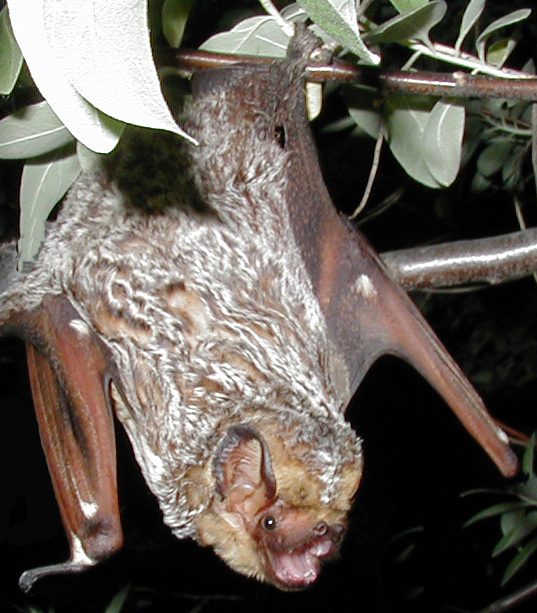
The big brown bat is the species found most often in northern Colorado buildings; it was the species KUNC pictured when it reported the 2025 Mead case. The Colorado Bat Working Group describes summer groups of big brown bats in buildings as maternity colonies, made up of females raising their young. The Little Thompson River, the Hillsboro Ditch that runs through town and the reservoirs and farm ponds around Johnstown produce plenty of night-flying insects. CPW lists both Weld and Larimer among the counties where white-nose syndrome has been confirmed (Boulder, Douglas, El Paso, Grand, Jefferson, Larimer, Otero, Routt, Teller and Weld), another reason exclusion should let every bat leave unharmed.
From sugar-beet town to a town of 20,000
Harvey J. Parish platted Johnstown in November 1902 where branches of the Great Western Railway's "sugar beet road" met. He named it for his seven-year-old son, John, who was in a Denver hospital with a ruptured appendix at the time. John recovered and later served as mayor from 1929 to 1934. Great Western built a sugar factory in town in 1925–26, and the National Register nomination for the Parish House notes that the town's oldest residential streets lie west of downtown.
That historic core is now a small part of the town. The Census Bureau's Vintage 2024 estimate puts Johnstown at 20,639 residents, up from about 17,400 in 2020. Of its 7,124 housing units, the median was built in 2007; 41% went up in 2010 or later and only 10% predate 1980. About 79% are single-family detached houses and 22% of homes are rented (ACS 2024 5-year).
In older homes near downtown, bats tend to use gaps at fascia boards, around chimneys and at loose siding. On newer two-story houses, the usual openings are where a garage roof meets the main wall, at soffit returns, around unscreened gable vents and at the ends of ridge vents. A bat can fit through a gap about the width of a thumb, and the Working Group warns that blocking the main exit while bats are inside can push them to find another way out, sometimes into the living space.
When bat exclusion can happen in Johnstown
Colorado Parks and Wildlife asks property owners to avoid sealing bats out of buildings during pupping season, June through August. The Colorado Bat Working Group gives a slightly longer window (June to mid-August) and asks a simple question first: can the work wait until the maternity colony disperses in autumn? NOAA has no long-term normals station in Johnstown itself; the Loveland 2N station, about 13 miles northwest, averages a November low near 21°F, well after colonies break up.
In Johnstown, NOAA normals for the Loveland 2N station put the average low at 50°F or warmer in Jul–Aug, the stretch when insects, and therefore bats, are most active. That lines up with the state window. We use those months for inspection and night exit counts. One-way doors go up after the pups can fly, and stay up for the 5–10 nights the Working Group recommends before the last gaps are sealed.
Johnstown at a glance
- Housing units: 7,124 (median year built 2007)
- Built before 1980: 10%; built 2010 or later: 41%
- Single-family detached: 79%; buildings with 10+ units: 11%
- Renter-occupied homes: 22%
- Average January low: 13°F; average July high: 89°F
- Months with an average low of 50°F or warmer: Jul–Aug
Housing figures: U.S. Census Bureau, ACS 2024 5-year estimates (tables B25024, B25034, B25035, B25003) via Census Reporter. Climate: NOAA 1991–2020 normals, Loveland 2N station.
Common questions
Who do I call about a bat in my Johnstown home?
If anyone may have touched it, or it was in a room with someone asleep, call public health before you release it. On the Weld County side that is WCDPHE at 970-400-2290 (after hours, Weld dispatch at 970-350-9600, option 1). In the Larimer County part of town, call NOCO Humane at 970-226-3647 ext. 7.
Will the Johnstown Police remove bats from my attic?
No. The town says its police generally respond to wildlife only when there is an immediate risk of serious injury or death to people. A colony living in an attic or wall is private exclusion work.
How common are rabid bats in Weld County?
Weld County health records show 5 rabid bats in 2025 and 6 in 2024, and the first rabid animal in Colorado in 2025 was a bat found near Highland Lake in Mead. Most bats are not rabid, but a grounded or indoor bat should never be handled.
My Johnstown house is only a few years old. Can bats still get in?
Yes. Bats can use gaps where a garage roof meets the wall, soffit returns, unscreened gable vents and ridge-vent ends. A gap about the width of a thumb is enough, so we inspect new houses the same way as old ones.
When can bats be sealed out of a Johnstown home?
Not during pupping season, June through August, according to Colorado Parks and Wildlife. After the young can fly, one-way devices stay up for 5 to 10 nights before the last gaps are sealed. Late summer and early fall are the usual window.
Nearby city guides
Sources
- Town of Johnstown: FAQ, What do you do about nuisance wildlife? (police respond only to immediate threats)
- Town of Johnstown: Police FAQs (animal bites, deceased wildlife, Public Works 970-578-9622)
- Town of Johnstown: About the Johnstown Police Department (970-587-5555; non-emergency 970-356-1212)
- Weld County Department of Public Health and Environment: Rabies (bat exposure guidance; historical rabies cases by year)
- Weld County: Bat tests positive for rabies in Weld County (May 7, 2025; WCDPHE 970-400-2290)
- Larimer County: Rabid bat found in Larimer County (May 19, 2026; NOCO Humane 970-226-3647 ext. 7; LCDHE hotline 970-498-6666)
- KUNC: Rabid bat found in Weld County (May 16, 2025)
- Colorado Parks and Wildlife: Contact us (regional and area offices)
- History of Weld: Johnstown, Weld County Towns: The First 150 Years (City of Greeley Museums, PDF)
- National Park Service: National Register nomination, Harvey J. Parish House, Johnstown (sugar factory 1925-26)
- U.S. Census Bureau: City and town population estimates, Vintage 2024 (SUB-EST2024)
- Colorado Parks and Wildlife: Living with Bats
- Colorado Bat Working Group (CNHP, CSU): excluding bats from buildings
- CDPHE: Colorado Rabies FAQ
- Colorado Parks and Wildlife: Protect your home from wildlife
- Census Reporter: Johnstown profile (ACS 2024 5-year)
- NOAA NCEI 1991–2020 monthly normals (Loveland 2N)
Other Colorado cities we serve
We serve all of Colorado. Here are nearby service areas.
Johnstown bat removal, done right.
Call for a phone consultation. Written warranty.